Bells of Steel / Cable machines
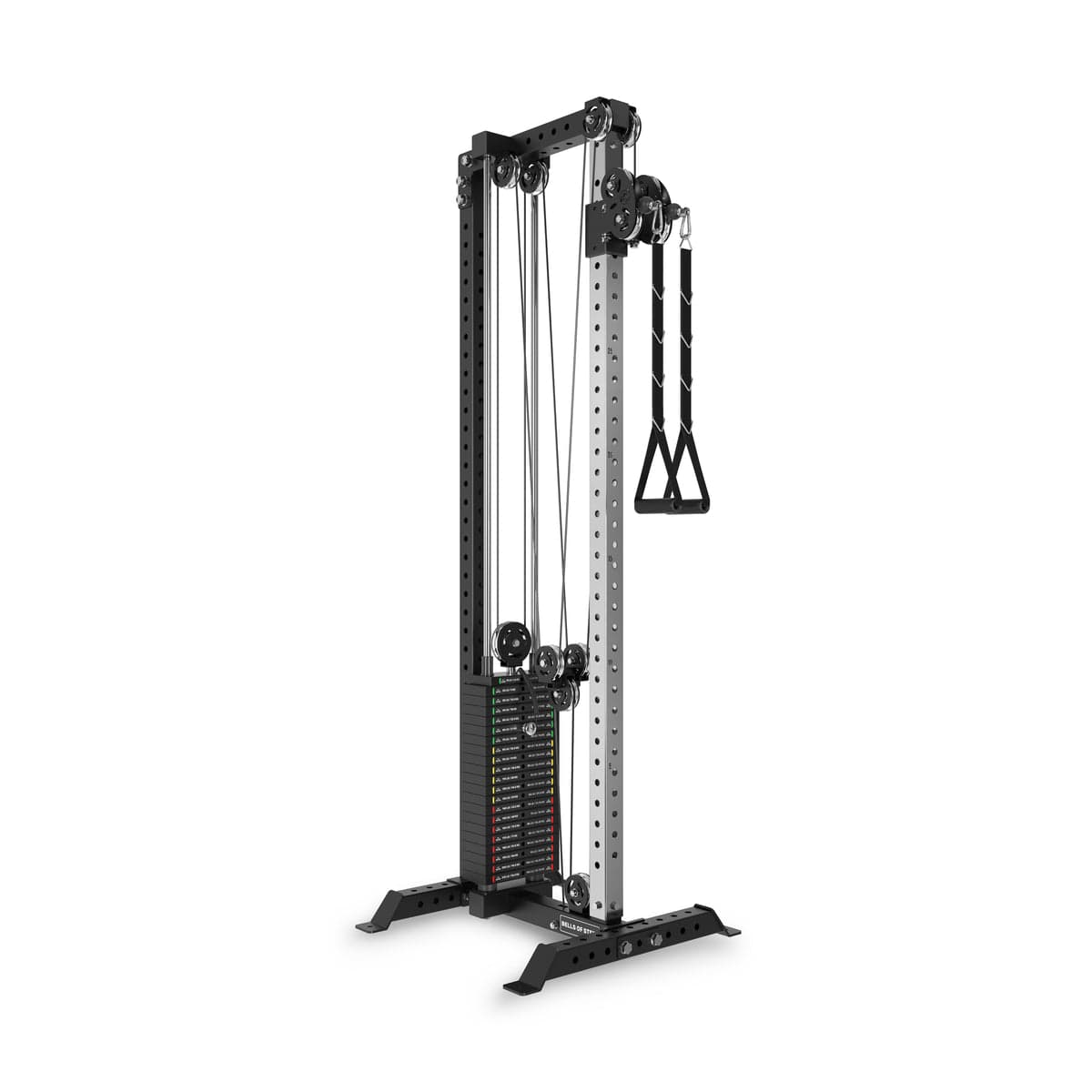
Bells of Steel Cable Tower
A compact cable tower with wall, floor, and rack mounting paths for a small room where the footprint is limited but a verified bolt-down boundary is possible.
Best fit when
- A small room that can verify wall, floor, or rack mounting before use
- People who value a compact tower and multiple mounting or ratio configurations
Choose another path when
- You cannot bolt the tower down or need a cable station that can be moved after every session
Training jobs
What earns the floor space.
- 01Add a compact vertical cable path for rows, pulldowns, presses, and accessory work
- 02Choose between plate-loaded and selectorized resistance formats while keeping the tower under a small-room footprint
Sourced specifications
Facts with a visible source.
Test queue
The protocol is assigned. The result is not.
Documents one cable-machine sample's dimensions, pulley path, adjustment range, attachment handling, installation boundary, and room envelope without certifying a structure, cable rating, exercise, or user's capacity.
- Hands-on gate
- 3 measurements / 4 observations
- Long-term gate
- 90 days / 20 sessions
0 completed first-party sessions. This record remains spec-reviewed, and no measurement or use result is implied.
- 01Machine dimensions3x
Record assembled height, width, depth, stored profile, and the marked working envelope at repeatable reference points.
- 02Adjustment range3x
Record the available pulley, trolley, seat, handle, and attachment positions without turning adjustment count into a fit guarantee.
- 03Cable travel3x
Measure the usable unloaded cable path and identify the stop, return, and pinch boundaries for the recorded configuration.
- 04Attachment handling3x
Document included handles, bars, straps, pins, clips, adapters, and the order needed to change them without treating handling as a durability claim.
- 05Stack or loading path3x
Record the selector pin, plate-loading sleeve, adapter, and return path without converting a declared stack or ratio into a personal prescription.
- 06Installation and clearance3x
Measure the approach, assembly, pull-up, cable, wall, floor, ceiling, and return clearances needed for the declared room boundary.
- 07Unloaded pulley path3x
Record smoothness, contact points, pinch points, visible alignment, and stop conditions during controlled unloaded movement.
- 08Ownership condition log1x
Record changes in cable, pulleys, frame, pins, attachments, finish, and mounting contact over time without creating a universal durability result.
Tradeoffs
What the recommendation does not hide.
- The compact frame can fit more rooms than a full functional trainer but gives up some standalone stability and attachment breadth
- The 2:1 and 1:1 options widen the use cases while adding an adapter and configuration decision