Rogue Fitness / Medicine balls
Rogue Medicine Balls
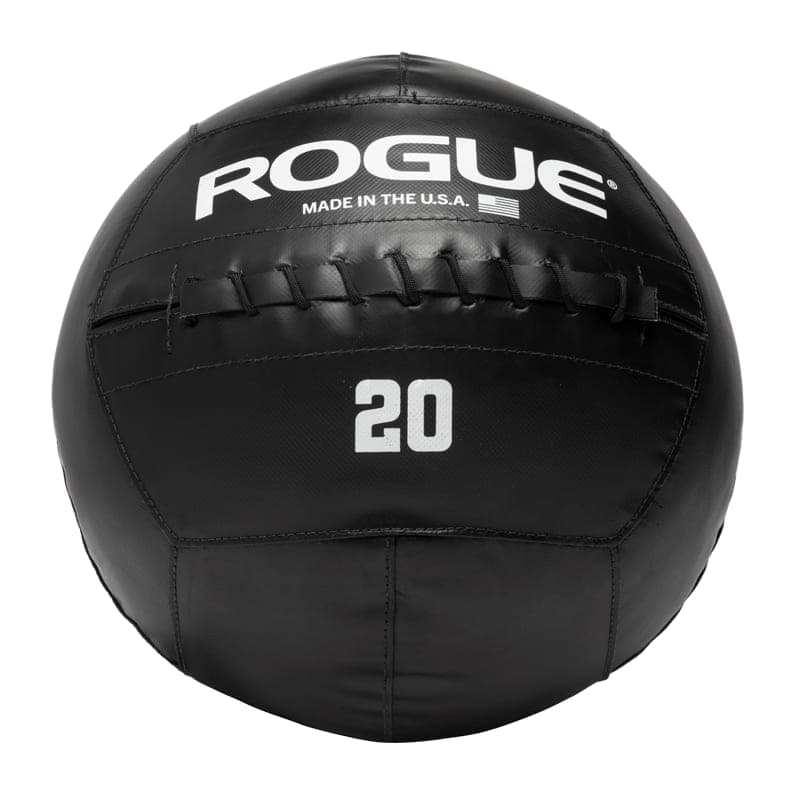
A 14-inch soft-shell medicine-ball line with eleven listed weight options for throws, catches, wall-ball rhythm, and non-impact loading.
Best fit when
- A room with a defined wall, partner, or open release path
- People who want a catchable ball format that is explicitly separate from slam work
Choose another path when
- Your primary job is repeated overhead slamming or dead-bounce impact
- You cannot verify the target, catch zone, ceiling, and storage route
Training jobs
What earns the floor space.
- 01Support repeatable throws, catches, wall-ball rhythm, and front-held loading
- 02Keep one diameter while progressing through a listed range of ball weights
Sourced specifications
Facts with a visible source.
- Declared use boundary
- The manufacturer describes throws, catches, wall-ball work, and other non-slam applications Source
Test queue
The protocol is assigned. The result is not.
Documents one medicine-ball sample's diameter, mass label, handling features, target and catch clearance, storage path, and ownership wear within stated manufacturer limits.
- Hands-on gate
- 3 measurements / 4 observations
- Long-term gate
- 90 days / 20 sessions
0 completed first-party sessions. This record remains spec-reviewed, and no measurement or use result is implied.
- 01Overall diameter3x
Record the sample diameter that affects catch, target, and storage clearance.
- 02Listed mass check3x
Record the sample mass and compare the result with its visible listed label.
- 03Handle and grip clearance3x
Record the usable handle or grip opening that changes the catch and carry path.
- 04Target throw sequence3x
Observe the setup, release, target contact, and recovery sequence under the declared use boundary.
- 05Catch and reset3x
Observe the catch, deceleration, return, and set-down path without treating handling as a safety guarantee.
- 06Shell and seam response3x
Observe visible shell, seam, handle, and shape changes during the repeated declared-use circuit.
- 07Storage move3x
Observe the handling, clearance, and reset required to return the ball to its intended storage home.
- 08Ownership wear log1x
Record shell, seam, handle, label, and surface changes over time.
Tradeoffs
What the recommendation does not hide.
- The consistent 14-inch diameter keeps the format familiar while the selected weight changes the handling demand
- The soft shell and declared catch format do not certify your wall, partner, floor, or room boundary
Where it fits
Included in a complete setup.
Read the decision
Guides that put this record in context.
Choose the lightest medicine ball that lets you complete the intended throw, catch or recovery, and reset path without changing the target, stance, or release. Then verify the ball diameter, wall and ceiling boundary, catch lane, storage home, and the manufacturer's declared use. A heavier ball is not automatically a better power tool, and a soft medicine ball is not a slam ball.
ConditioningSlam ball or medicine ball: which power tool fits your room?Choose a slam ball when the training job includes controlled ground releases, dead-bounce recovery, and a surface that can receive repeated impact. Choose a medicine ball when throws, catches, wall-ball rhythm, or non-impact loading are the actual job. Then choose shell texture, weight range, storage, and return path. If you cannot name the surface and recovery lane, keep the current tool and solve that constraint before shopping.