Rogue Fitness / Plyo boxes
Rogue Foam Plyo Boxes
A stackable multi-height foam box system for a conditioning room where a forgiving edge and multiple low-to-high step or jump heights matter, but the floor surface must be checked before use.
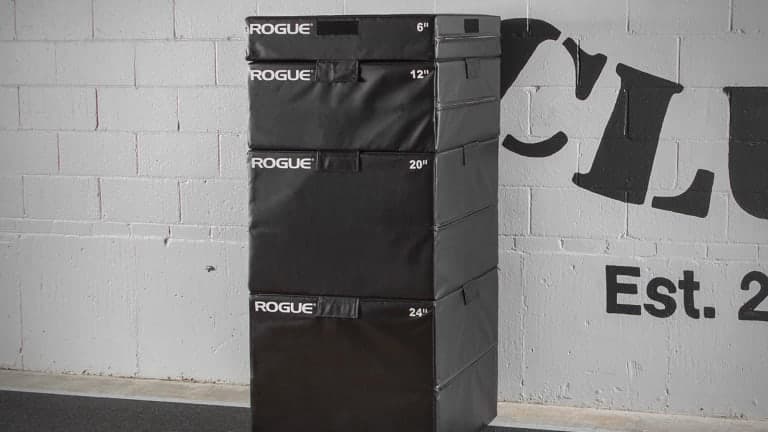
Best fit when
- A dedicated conditioning room that can provide a suitable non-smooth surface and storage for stacked foam sections
- People who want 6, 12, 20, and 24 inch height options in one modular product family
Choose another path when
- You cannot verify the surface, stack stability, landing envelope, and storage path before use
Training jobs
What earns the floor space.
- 01Create a height-scaled step-up and plyometric progression without buying four separate rigid boxes
- 02Provide a visible target for controlled squat-to-box and lower-body conditioning work
Sourced specifications
Facts with a visible source.
Test queue
The protocol is assigned. The result is not.
Documents one plyo-box sample's dimensions, height configuration, assembly, surface contact, storage path, and controlled unloaded handling without certifying a landing, floor, structure, product capacity, or user's jumping ability.
- Hands-on gate
- 3 measurements / 4 observations
- Long-term gate
- 90 days / 20 sessions
0 completed first-party sessions. This record remains spec-reviewed, and no measurement or use result is implied.
- 01Box dimensions3x
Record height, width, depth, top platform, base footprint, and stored profile at repeatable reference points.
- 02Height configuration3x
Record the available rotation, stack, height, pin, hook-and-loop, or variant configurations without converting a setting into a personal prescription.
- 03Assembly and joints3x
Document fasteners, seams, puzzle joints, covers, panels, handles, and visible engagement points on the sample.
- 04Surface and contact3x
Record the top surface, base contact, edge condition, floor interface, and declared surface warnings without certifying grip or stability.
- 05Handling and storage3x
Measure the approach, carry, stack, rotate, and return path for the recorded box configuration.
- 06Clearance envelope3x
Record the empty approach, overhead, side, rear, landing, and walk-around envelope required by the declared use boundary.
- 07Controlled step path3x
Record unloaded step-up and step-down handling, visible movement, edge contact, and stop conditions without making a jump-performance claim.
- 08Ownership condition log1x
Record changes in surfaces, seams, joints, fasteners, handles, base contact, and storage wear over time without creating a universal durability result.
Tradeoffs
What the recommendation does not hide.
- The foam construction creates a softer contact boundary than a rigid box while increasing the importance of surface and stack checks
- Multiple heights support progression but the 28 by 28 inch footprint and stacked storage still need a dedicated return path
Where it fits