Name the job
Decide what the box needs to repeat before choosing its material.
A box can provide a step-up target, a controlled squat reference, a support for a variation, or a platform for a plyometric progression. Those jobs need different heights, surfaces, storage, and approach paths. Write the movement you will repeat and the room use that must remain possible after the session. If the job is still a vague promise to train harder, a box is an expensive way to preserve the question.
The resistance-training position stand supports matching training mode and equipment to a person's goal, schedule, and available resources. That supports a fit decision. It does not make box jumps necessary, prescribe a height, or validate one manufacturer's capacity for a particular person.
- acsm-resistanceAmerican College of Sports MedicineProfessional consensus
Compare materials
Foam, resin, and wood solve different room problems.
Rogue's Foam Plyo Boxes offer 6, 12, 20, and 24 inch sections with a 28 by 28 inch footprint. Rogue's Resin Plyo Box offers 12, 18, 20, and 24 inch rigid options with a smaller top and overlapping storage. Titan's 3-in-1 Wooden Plyo Box uses one plywood platform in three orientations, while its 12-inch Stackable Wooden Plyo Box is a low modular starting point for a compatible stack. These are manufacturer specifications and formats, not independent performance rankings.
Foam changes the edge and stack boundary. Resin changes assembly, transport, and rigid contact. Wood changes the permanent platform and the need to verify the floor and landing envelope. Pick the boundary you can actually inspect and repeat, not the material that sounds most serious.
- rogue-foamRogue FitnessManufacturer source
- rogue-resinRogue FitnessManufacturer source
- titan-3in1Titan FitnessManufacturer source
- titan-stackableTitan FitnessManufacturer source
Verify the surface
The floor is part of the box, not a footnote.
Rogue explicitly warns against using its foam boxes on smooth flooring and says the resin boxes should not be used on hard or smooth surfaces. Titan's wood pages call for a non-slip surface and say not to use the three-in-one box on slick surfaces. Those statements define a manufacturer boundary. They do not certify your floor, your landing, or the stability of a complete room.
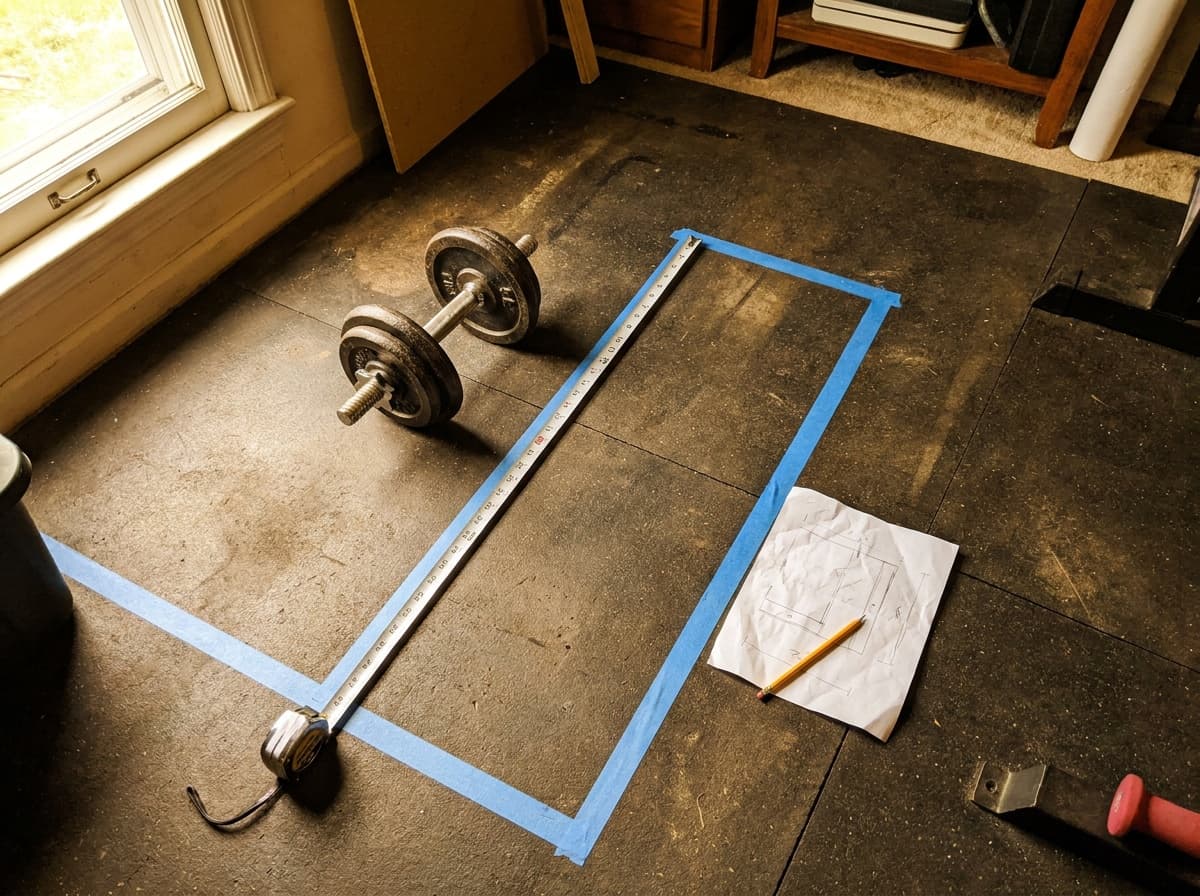
Tape the base, approach, side clearance, landing area, ceiling, nearby furniture, and return route. Check every chosen height and every stack or rotated configuration on the actual surface. If the box moves, the surface changes, or the room cannot keep the lane clear, stop and change the training job or the format.
- rogue-foamRogue FitnessManufacturer source
- rogue-resinRogue FitnessManufacturer source
- titan-3in1Titan FitnessManufacturer source
- titan-stackableTitan FitnessManufacturer source
- cpsc-recallsU.S. Consumer Product Safety CommissionPublic-health guidance
Choose storage
A box that blocks the room will not create a repeatable week.
Foam sections can stack into a height family, resin boxes can overlap after assembly, and Titan's wood options trade one platform or a low modular box against more rigid storage. The relevant question is not which box has the most orientations. It is whether you can move it into place, use it, and return it without crossing the bar path, cardio lane, or shared-room circulation.
Record the carry distance, hand-hold position, stored height, and return route. Keep the chosen format separate from any claim about durability or ease. Those require a first-party session under the plyo-box protocol and still apply only to the recorded sample and conditions.
- rogue-resinRogue FitnessManufacturer source
- titan-3in1Titan FitnessManufacturer source
- titan-stackableTitan FitnessManufacturer source
Choose the next move
Buy the box only when the room can repeat the movement.
Choose Rogue Foam when several heights and a softer edge fit the room's verified surface boundary. Choose Rogue Resin when rigid height options and compact overlapping storage matter. Choose Titan's three-in-one wood box when one assembled platform earns a dedicated lane. Choose Titan's low stackable box when a lower step-up target and modular height path are the real job. Choose no box yet when the floor, room, or training decision is unresolved.
The connected records keep these paths visible without turning a spec-reviewed product into a finished review. The Weighted Strength and Conditioning Station already holds the rest of the conditioning graph, so the box can be a deliberate branch rather than a new room system.
- rogue-foamRogue FitnessManufacturer source
- rogue-resinRogue FitnessManufacturer source
- titan-3in1Titan FitnessManufacturer source
- titan-stackableTitan FitnessManufacturer source
- cpsc-recallsU.S. Consumer Product Safety CommissionPublic-health guidance