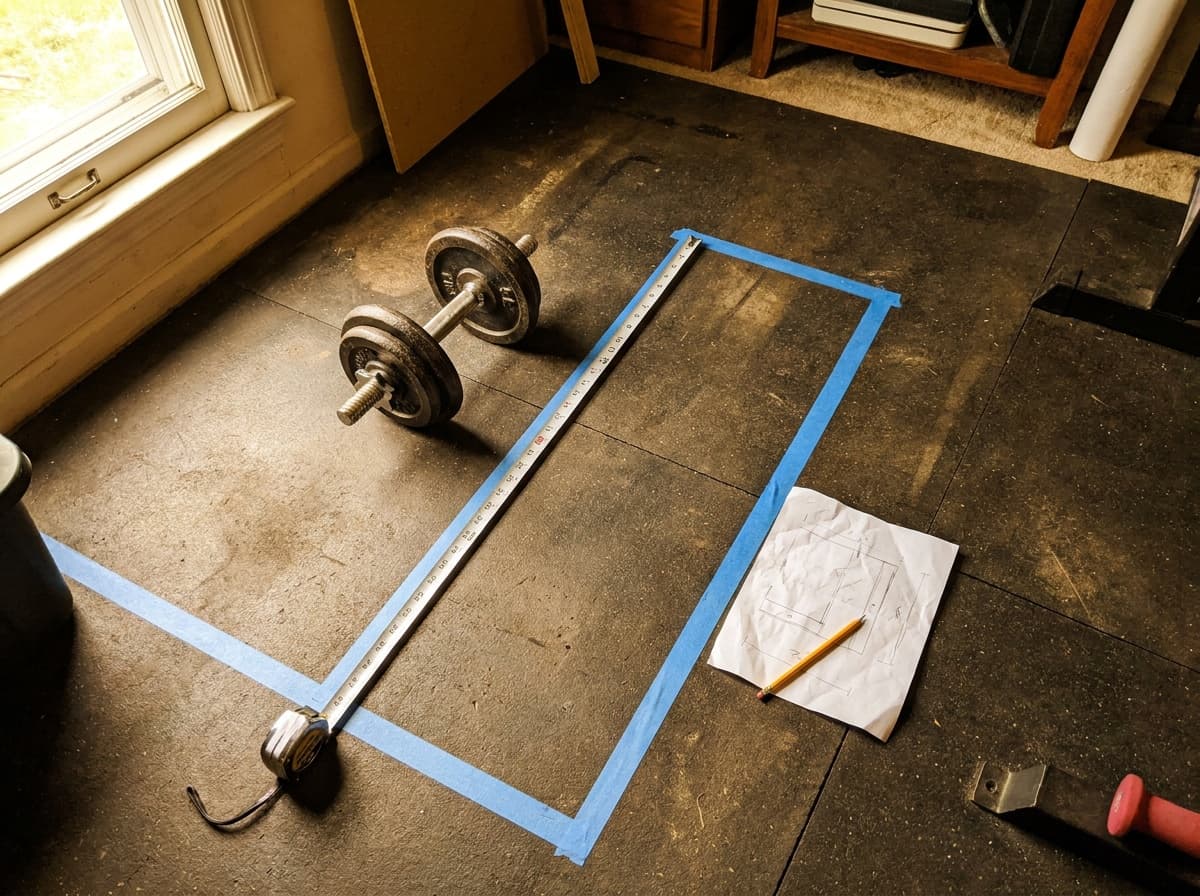
Start with use
Name the job before you choose the material.
If the room mainly supports mobility, floor strength, or bodyweight work, a thin training mat may be enough to define the surface. If benches, bikes, loaded carries, or controlled drops stay in the room, the surface has to manage equipment contact, cleaning, and repeated circulation as well as exercise comfort.
Choose the smallest surface that makes the planned work easier to repeat and still fits the room, subfloor, and building.
- nrc-impact-floorNational Research Council CanadaProfessional consensus
Choose a format
Compare thin mats, tiles, and rolls by the room they create.
A thin mat is portable and easy to reset, but it is not an impact floor or a structural solution. Interlocking tiles create a reconfigurable equipment zone. Rolled rubber can cover a larger continuous area, but carrying, trimming, seams, and installation become part of the project.
The American Floor Mats Performance-Lock record lists 1/2-inch tiles, 23 by 23-inch modules, an interlocking system, and no adhesive requirement. REGUPOL's aktiv guidance describes rolled formats and multiple thickness options. Those are source-backed product facts, not a universal ranking.
- american-floor-matsAmerican Floor MatsManufacturer source
- regupol-aktivREGUPOL AmericaManufacturer source
Keep the boundary
Treat impact protection and sound transmission as separate questions.
A rubber floor can change contact, vibration, and surface feel, but the result depends on the subfloor, structure, equipment, and action. A thicker surface is not a promise that a neighbor will hear nothing, and a product page's noise language is not a room-specific measurement.
For persistent transmission, structural loading, or a requirement for soundproofing, involve the landlord, building manager, engineer, or acoustics professional. Keep the workout plan inside the boundary you can actually verify.
- nrc-impact-floorNational Research Council CanadaProfessional consensus
- regupol-aktivREGUPOL AmericaManufacturer source
Match the format
Choose the surface that matches the session and the reset you can repeat.
REGUPOL Aktiv rolls cover a larger area with fewer seams, but a 25- or 50-foot roll turns delivery, carrying, trimming, and storage into part of the room plan. Rogue's 1.5-inch rubber tiles create a dense modular lifting or landing zone, while AktivLok's 3/8-inch interlocking tiles trade some thickness for a lower transition and easier repositioning.
Dollamur GymTurf solves a different job: a roll-out lane for sled pushes, sprint drills, and agility that can be stored after conditioning. It is not a replacement for impact flooring under a rack or a guarantee of traction, noise reduction, or structural protection in every room.
- rogue-aktivRogue FitnessManufacturer source
- rogue-rubber-tileRogue FitnessManufacturer source
- rogue-aktivlokRogue FitnessManufacturer source
- rogue-gymturfRogue FitnessManufacturer source
Before ordering
Measure the edges that make flooring succeed or fail.
Measure door swing, threshold height, baseboards, equipment feet, bench storage, and the path used to carry a tile or roll into the room. Interlocking systems still need seam alignment and edge inspection. A floor that fits its rectangle but blocks the door or catches a bench wheel is not a complete solution.
Also record the care boundary. Rubber products may have installation, ventilation, cleaning, and odor considerations that belong in the room plan rather than being discovered after the equipment arrives.
- american-floor-matsAmerican Floor MatsManufacturer source
- regupol-aktivREGUPOL AmericaManufacturer source
- rogue-aktivRogue FitnessManufacturer source
- rogue-rubber-tileRogue FitnessManufacturer source
- rogue-aktivlokRogue FitnessManufacturer source
- rogue-gymturfRogue FitnessManufacturer source