Restart / 4 weeks
The 30-Minute Restart
Rebuild a dependable training week without trying to win the first session.
A four-week, bodyweight-first plan for people returning to structured training who need a clear rhythm, modest volume, and room to relearn the movements.
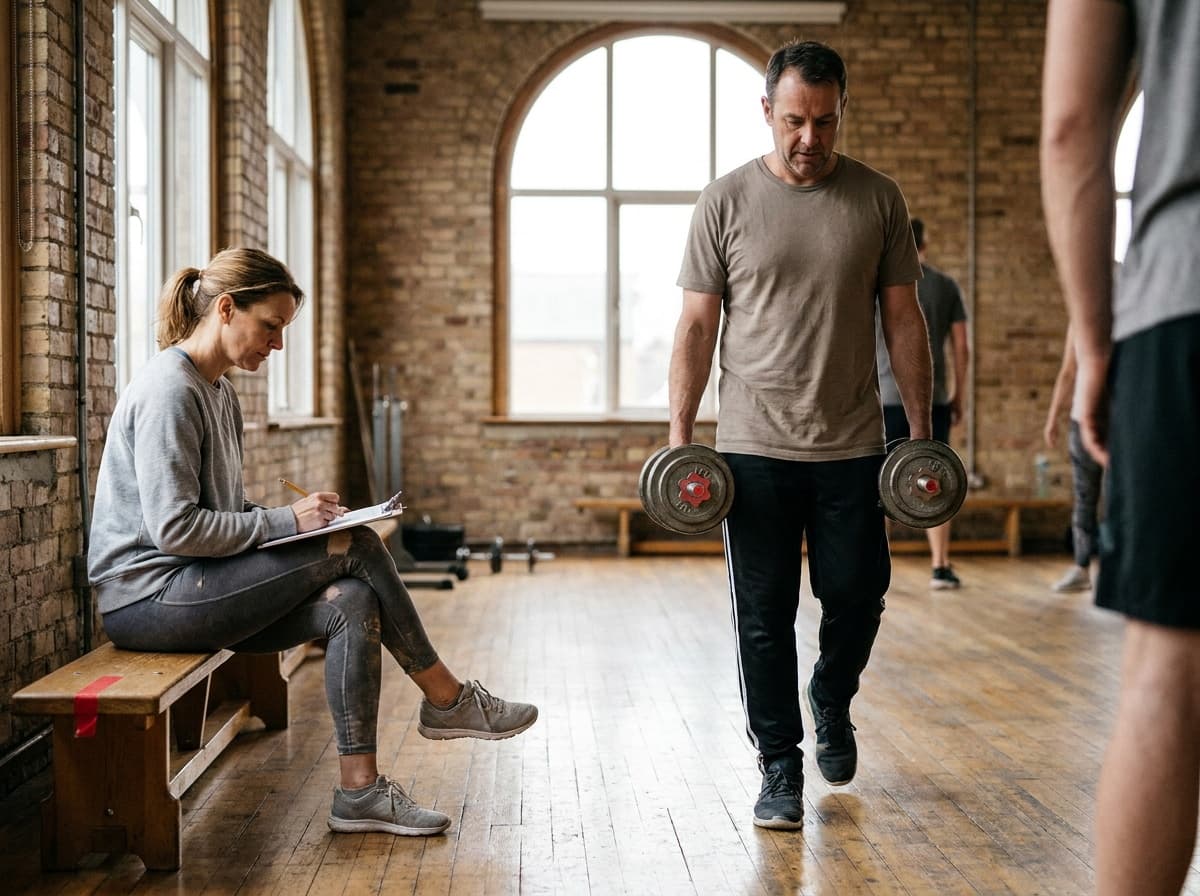
Fit before effort
Know what you are choosing.
A useful fit when
- You want three short full-body sessions with minimal setup.
- You are returning after an ordinary lapse and can manage daily activity comfortably.
- You value consistency and movement control more than aggressive loading.
Choose another path when
- You have a current injury, unexplained symptoms, or a rehabilitation plan that requires individual supervision.
- You already train consistently and need a higher-volume strength progression.
Progression map
Change one thing at a time.
Weeks 1 to 2
Find the rhythm
Learn the session order and finish each block with room to repeat it.
Keep the lower prescription until both sessions feel familiar.Weeks 3 to 4
Add a little work
Preserve the same movement quality while adding a small amount of volume.
Add one repetition per set or one short round, but not both at once.The training week
3 repeatable sessions.
Reset A
Practice a squat, push, pull, and trunk-control pattern at a calm pace.
Pause the set while foot pressure and depth still feel repeatable.
Swap: Split SquatRefine this swap by constraintUse the slower descent only while the whole foot and breathing stay steady.
Swap: Bodyweight Squat / Split SquatRefine this swap by constraintChoose an incline that lets the torso move as one piece.
Swap: Dumbbell Floor Press / Medicine Ball Chest Pass / Ring Push-Up / Sled PushRefine this swap by constraintUse a small range and keep the neck relaxed against the floor.
Swap: Anchored Band Row / Ring Row / Sled DragRefine this swap by constraintShorten the reach before the back position changes.
Swap: Pallof Press / Wall-Assisted Ab Rollout / Battle Rope Alternating Waves / Battle Rope Side-to-Side WavesRefine this swap by constraintReset B
Practice a hinge, single-leg pattern, carry, and controlled press.
Finish each repetition without chasing extra height.
Swap: Dumbbell Romanian DeadliftRefine this swap by constraintUse a support and a shorter range when balance limits the legs.
Swap: Bodyweight Squat / Sandbag Front SquatRefine this swap by constraintMove slowly enough that the trunk stays quiet.
Swap: Dumbbell Farmer Carry / Battle Rope Alternating WavesRefine this swap by constraintStop before the shoulders roll forward or the hips lag.
Swap: Standing Band Press / Medicine Ball Wall Throw / Ring Push-Up / Battle Rope Power SlamRefine this swap by constraintReset C
Repeat the core movement patterns with a slightly different order.
Use the same stance and range that worked earlier in the week.
Swap: Goblet SquatRefine this swap by constraintLead with the elbows without forcing the hands toward the floor.
Swap: One-Arm Dumbbell RowRefine this swap by constraintKeep the rib position quiet as the hips rise.
Swap: Band Good MorningRefine this swap by constraintExhale through the reach and reset before the next repetition.
Swap: Kettlebell HaloRefine this swap by constraintEnd the hold before the hip drops or the shoulder sinks.
Swap: Dead Bug / Pallof PressRefine this swap by constraintProgram evidence ledger
What the evidence supports.
A source can support a programming decision without validating every line of the template. Each note keeps that boundary visible.
Start below the destination.
Federal guidance advises inactive and low-activity adults to begin with manageable light or moderate work and increase frequency, duration, and effort gradually.
- U.S. Department of Health and Human ServicesPublic-health guidance
Progressive resistance still matters.
The 2026 ACSM position stand supports progressive resistance training and shows that multiple sets and regular weekly exposure can improve strength in healthy adults.
- American College of Sports Medicine via PubMed CentralProfessional consensus
Program source register
Inspect the programming trail.
Evidence notes above show what each source supports and where the Workout Authority template remains an editorial choice.
- 01Physical Activity Guidelines for Americans, second edition
U.S. Department of Health and Human Services
Public-health guidance / Accessed 2026-07-26 - 02Resistance Training Prescription for Muscle Function, Hypertrophy, and Physical Performance
American College of Sports Medicine via PubMed Central
Professional consensus / Accessed 2026-07-26
Equipment path
Complete setups that cover this program.
Read the decision
Guides that put this record in context.
There is no universal number. Distribute weekly strength work so the next planned session can keep its intended movement quality and effort; nonconsecutive full-body days are a useful starting pattern, not a biological law.
StrengthHow often should you strength train?Start with two or three sessions you can repeat for several weeks. The useful frequency is the one that leaves enough recovery and schedule space to practice the same work again.
StrengthHow to progress without testing yourself every workoutRepeat the same lifts under comparable conditions, keep technique and effort targets stable, and change one variable after you can complete the current work with control.