Strength / 6 weeks
Home Strength Foundation
Build useful full-body strength with a small dumbbell setup and a repeatable week.
A six-week, three-day strength plan that organizes squat, hinge, push, pull, carry, and trunk-control work around adjustable dumbbells and a stable bench.
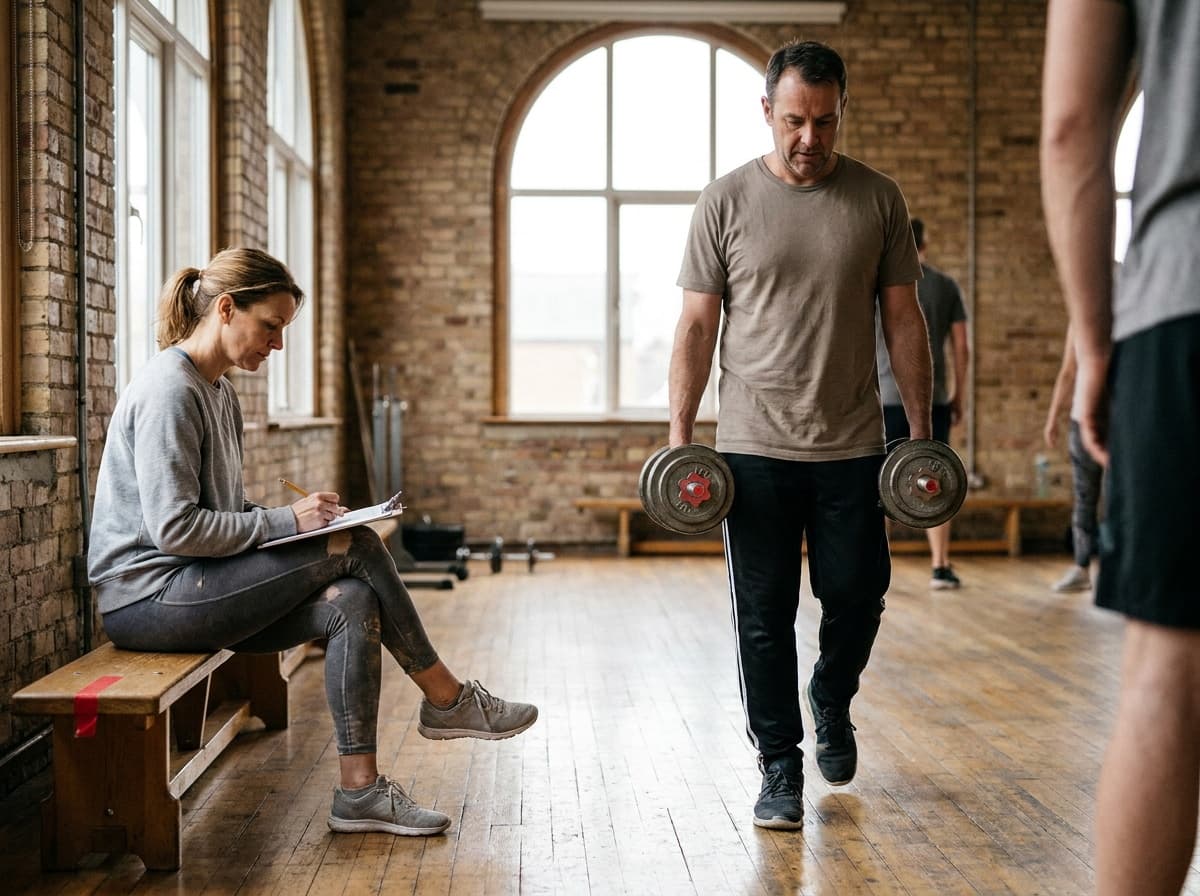
Fit before effort
Know what you are choosing.
A useful fit when
- You can train three nonconsecutive days and have adjustable dumbbells.
- You know the basic movement patterns but want a clearer progression.
- You want a full-body plan rather than a body-part split.
Choose another path when
- You need sport-specific peaking, advanced barbell programming, or individualized rehabilitation.
- You cannot yet perform the foundation exercise versions with a stable, comfortable range.
Progression map
Change one thing at a time.
Weeks 1 to 2
Establish the loads
Find conservative working weights and repeatable ranges for every exercise.
Add repetitions inside the listed range before adding weight.Weeks 3 to 4
Build the sets
Accumulate consistent work while preserving the same exercise standards.
Add the optional final set only when the earlier sets remain controlled.Weeks 5 to 6
Earn the next load
Reach the top of the repetition ranges without changing position or tempo.
Increase load only after repeating the top range in two sessions.The training week
3 repeatable sessions.
Strength A
Lead with the squat, then balance pressing, rowing, and loaded walking.
Choose a load that stays close without pulling the torso forward.
Swap: Bodyweight Squat / Slam Ball Bear-Hug Squat / Barbell Back SquatRefine this swap by constraintPause softly on the floor and keep the shoulders organized.
Swap: Incline Push-Up / Half-Kneeling Kettlebell Press / Barbell Bench PressRefine this swap by constraintKeep the front foot planted and finish the press without leaning away.
Swap: Standing Band Press / Dumbbell Floor PressRefine this swap by constraintUse the bench for support and keep the trunk still.
Swap: Anchored Band Row / Ring Row / Barbell RowRefine this swap by constraintUse a load that allows an even walk and normal control.
Swap: Bear Crawl / Front-Rack Kettlebell Carry / Sandbag Bear-Hug Carry / Ring Support Hold / Backward Sled DragRefine this swap by constraintStrength B
Lead with the hinge, then train single-leg strength, pushing, and bracing.
End the descent when the hinge position stops improving.
Swap: Band Good Morning / Kettlebell Deadlift / Sandbag Clean to Front / Barbell DeadliftRefine this swap by constraintUse dumbbells only after the stance and balance stay consistent.
Swap: Bodyweight SquatRefine this swap by constraintLower the incline only when the whole set remains clean.
Swap: Dumbbell Floor PressRefine this swap by constraintUse a reach that preserves steady trunk pressure.
Swap: Pallof Press / Slam Ball Rotational Toss / Medicine Ball Rotational Throw / Kneeling Ab RolloutRefine this swap by constraintStrength C
Repeat the major patterns with a modest density and control emphasis.
Use a lighter load than Strength A and keep the pace smooth.
Swap: Split SquatRefine this swap by constraintKeep the supporting shoulder and hips steady throughout.
Swap: Three-Point Kettlebell Row / Barbell RowRefine this swap by constraintKeep one or two clean repetitions available at the end.
Swap: Standing Band Press / Ring Push-UpRefine this swap by constraintWiden the feet and reduce the load before the hips rotate.
Swap: Dead Bug / Ab Wheel Isometric HoldRefine this swap by constraintWalk a clear lane and keep the trunk tall instead of leaning away from the load.
Swap: Dumbbell Farmer Carry / Front-Rack Kettlebell CarryRefine this swap by constraintProgram evidence ledger
What the evidence supports.
A source can support a programming decision without validating every line of the template. Each note keeps that boundary visible.
Three days distribute the weekly work.
Volume-equated frequency research reports similar strength gains across lower and higher resistance-training frequencies.
- American College of Sports Medicine via PubMed CentralProfessional consensus
- Sports Medicine Open via PubMed CentralSystematic review
Use progressive, multi-set resistance work.
The 2026 ACSM position stand supports progressive resistance training and reports stronger strength outcomes with variables including multiple sets and regular weekly exposure.
- American College of Sports Medicine via PubMed CentralProfessional consensus
Program source register
Inspect the programming trail.
Evidence notes above show what each source supports and where the Workout Authority template remains an editorial choice.
- 01Resistance Training Prescription for Muscle Function, Hypertrophy, and Physical Performance
American College of Sports Medicine via PubMed Central
Professional consensus / Accessed 2026-07-26 - 02Weekly Training Frequency Effects on Strength Gain: A Meta-analysis
Sports Medicine Open via PubMed Central
Systematic review / Accessed 2026-07-26
Read the decision
Guides that put this record in context.
Not reliably. Stretch after training if you enjoy it or have a separate flexibility goal, but current reviews do not show that it meaningfully reduces soreness or restores performance faster than no stretching.
StrengthFixed or adjustable kettlebell: which fits a small home gym?Choose a fixed kettlebell when one known load and immediate handling matter more than storage efficiency. Choose an adjustable kettlebell when several settings in one footprint solve a real room constraint and you can keep the bell off impact surfaces. If neither changes a defined training job, keep the purchase on hold and use the loading path you already have.
RecoveryHow many rest days do strength workouts need?There is no universal number. Distribute weekly strength work so the next planned session can keep its intended movement quality and effort; nonconsecutive full-body days are a useful starting pattern, not a biological law.
StrengthHow much strength training do adults need?Use two strength-training days per week as the public-health floor, cover the major muscle groups, and add work only when your goal, schedule, and recovery give you a reason to.
StrengthHow often should you strength train?Start with two or three sessions you can repeat for several weeks. The useful frequency is the one that leaves enough recovery and schedule space to practice the same work again.
ConditioningHow to combine strength and conditioning in one weekYes. For general fitness, strength and aerobic work can coexist; separate them or reduce the competing dose when one session repeatedly degrades the other, especially when explosive strength is the priority.
StrengthHow to progress without testing yourself every workoutRepeat the same lifts under comparable conditions, keep technique and effort targets stable, and change one variable after you can complete the current work with control.
StartingHow to start strength training at homeChoose a repeatable two-day plan, cover a squat, hinge, push, and pull across the week, keep the first sessions controlled, and progress one variable only after the work is dependable.
Home gymWhat should a first home gym buy first?Buy the smallest set that covers the training you will repeat: a progressive source of resistance, the floor or anchor support those movements need, and only then a bench or conditioning station that solves a defined gap.
MobilityWhat should a warm-up actually do?A warm-up should make the next task feel more familiar and ready: begin with easy activity, rehearse the movements and ranges you will use, then approach demanding work through progressive practice sets.